Doctor Golf
Optimizing Business Operations

Project Overview
Doctor Golf operates in the indoor golf services industry, specializing in simulator repairs, facility flooring installations, and ongoing equipment maintenance. Demand for these services is strong, but internal processes have not scaled at the same pace as customer expectations.
This case study examines how delays in procurement approvals, outdated vendor contracts, and the absence of customer loyalty systems have reduced service reliability and increased churn risk. The analysis focuses on how operational discipline and sequencing decisions can restore trust, improve turnaround times, and support long term growth.
Project Scope
Operational Strategy
Process Optimization
Performance Management
Applications & Tools
Adobe InDesign
Adobe Illustrator
Duration
Start – November 2025
End – December 2025
Analyzing The Business
Objective
Identifying operational and strategic changes that improve service reliability, reduce delays, and strengthen repeat customer retention before further expansion.
Business Problem
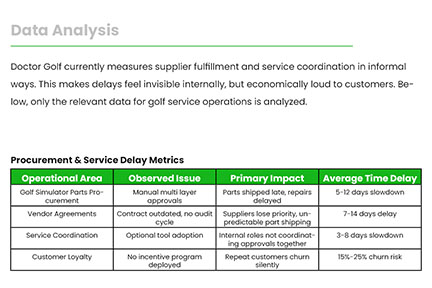
Doctor Golf is experiencing avoidable service delays driven by internal inefficiencies rather than lack of demand. Procurement approvals pass through too many manual steps, vendor agreements are outdated and rarely audited, shared internal tools are optional, and repeat customers are not formally incentivized.
These issues have led to parts procurement delays of 5 to 12 days, inconsistent vendor shipping timelines, and simulator repair turnaround times averaging 18 to 26 days, longer than customers expect in a parts-dependent service industry. Without intervention, repeat customer churn risk is estimated between 15% and 25%
Context & Constraints
Several factors shaped the decision environment:
-
High customer expectations: Reliability and turnaround time are critical in indoor golf operations
-
Vendor dependency: Parts availability is tied closely to contract terms and priority status
-
Internal fragmentation: Decision ownership and tool adoption are inconsistent
-
Growth pressure: Expansion is being considered before internal reliability is stabilized
These constraints meant that growth initiatives could not succeed without first improving internal execution.
My Role
This project was completed as an individual business case analysis. I was responsible for:
-
Diagnosing operational bottlenecks using provided data
-
Analyzing procurement, vendor, and service coordination workflows
-
Evaluating strategic alternatives using defined decision criteria
-
Developing the recommended sequencing plan and action roadmap
The work focused entirely on operational and strategic reasoning rather than visual or product design.
Approach & Business Thinking
Prioritizing Reliability Before Growth
The analysis reframed the problem away from demand generation and toward execution reliability. Growth was not the issue. The real risk was expanding services before approvals, vendors, and internal coordination could consistently meet timelines.
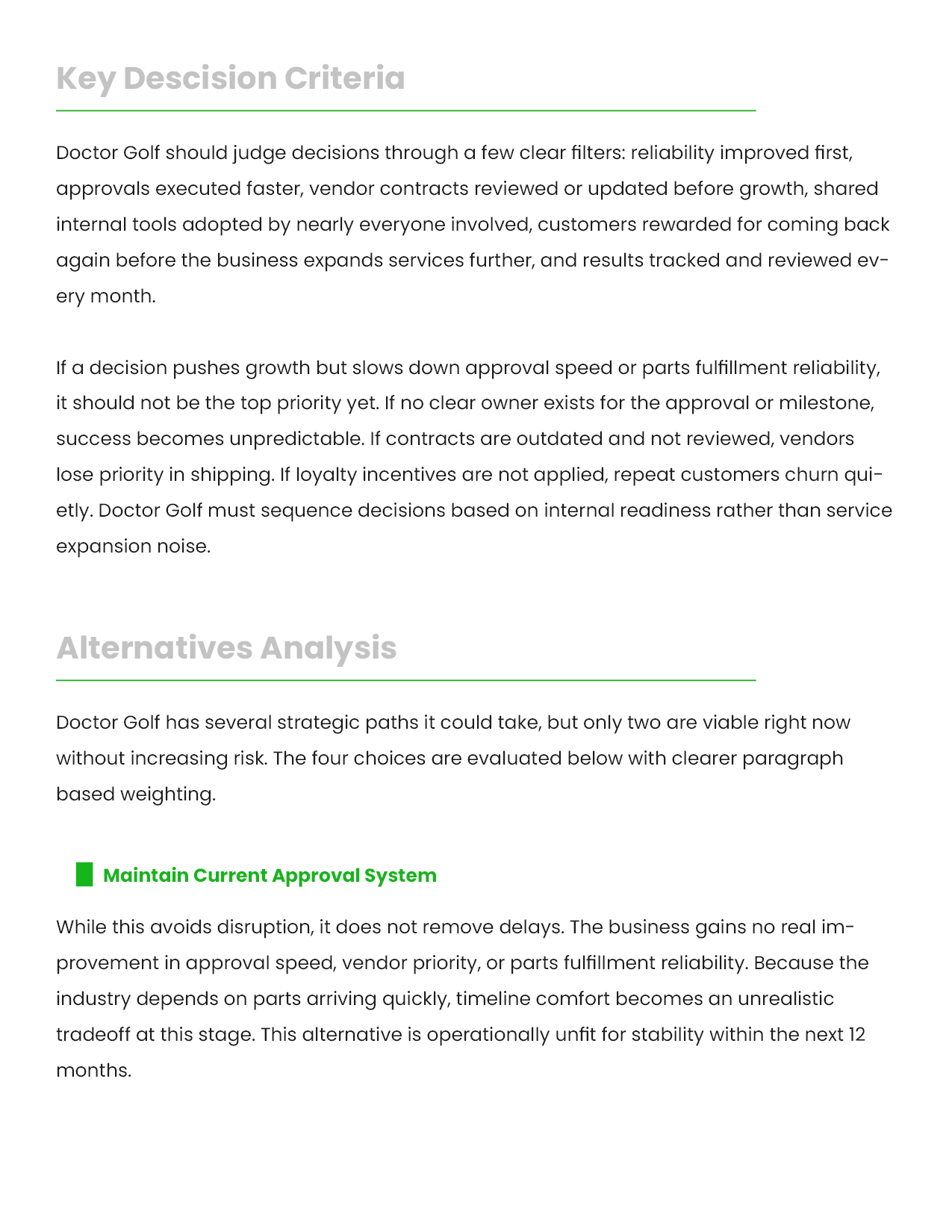
Clear decision filters were established to evaluate options:
-
Does this improve approval speed?
-
Does it restore vendor priority?
-
Does it improve reliability before expansion?
-
Can performance be measured monthly?
Any option that increased growth while weakening reliability was deprioritized
Strategic Alternatives Considered
1
Maintain Current Approval Systems
This option avoided disruption but preserved all existing delays and reliability issues.
2
Simplify Procurement Approvals
Removing unnecessary manual layers improved accountability and reduced delays, but required mandatory tool adoption.
3
Expand Services Immediately
This option increased risk by layering growth onto already unstable operations.
4
Audit Vendor Contracts & Introduce Customer Loyalty Incentives
Modernizing vendor agreements restored shipping priority, while loyalty incentives addressed silent customer churn.
Recommendation & Rationale
The recommended approach was to sequence operational improvements before expansion. Specifically:
-
Simplify procurement approvals
-
Audit and modernize vendor contracts
-
Make internal coordination tools mandatory
-
Introduce customer loyalty incentives
-
Track performance metrics monthly
This path improved reliability, restored vendor alignment, and reduced churn risk, while preserving the option to expand services once internal discipline was established.
Action Plan
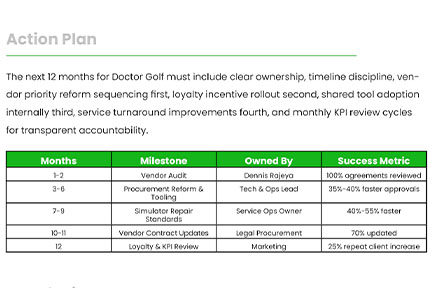
The strategy was supported by a 12-month execution roadmap that assigned clear ownership and measurable outcomes:
This phased plan emphasized accountability and continuous review rather than one time fixes.
Outcome
This case study reinforced the importance of operational sequencing in service-based businesses. Growth is only effective when internal systems can reliably support it. Without clear ownership, disciplined approvals, and measurable performance tracking, even strong demand can lead to customer frustration and churn.
The project strengthened my ability to analyze operational systems, identify hidden bottlenecks, and recommend realistic strategies that align ambition with execution.